
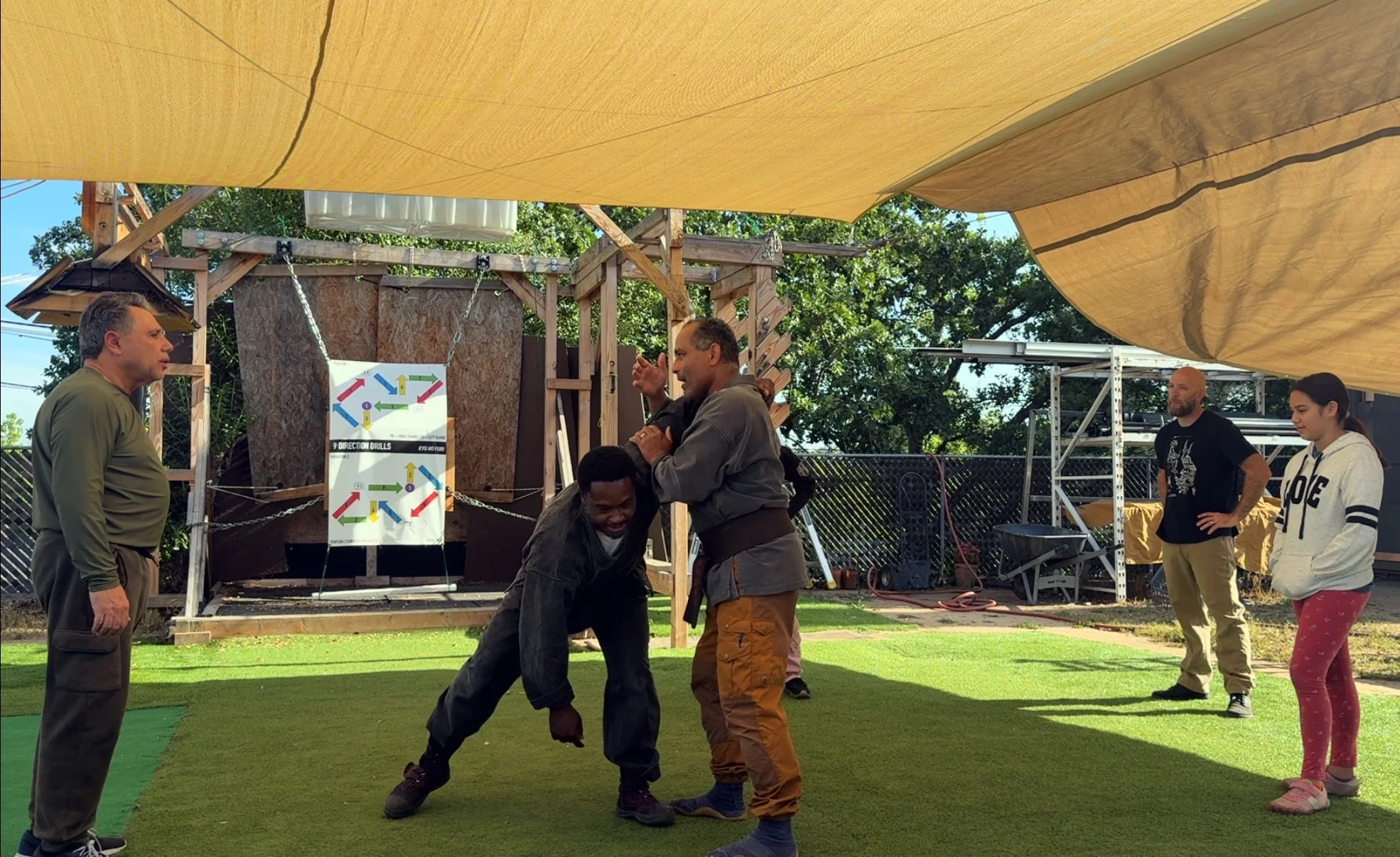
Adult Martial Arts in Newbury Park / Thousand Oaks
Practical martial arts for adults & Teens 16+
Combat Body Mechanics teaches a mixed martial system that combines striking, grappling, weapons, and movement. Training in a broad skillset shows students how to use martial arts in a real-world context.
Adults 16+ learn how to move, think, and respond under pressure.
Our training is built for people who want practical self-defense, better body mechanics, and a deeper understanding of how martial arts principles work.
Train at our Newbury Park studio: serving Thousand Oaks, Westlake Village, Agoura Hills, Camarillo, and the Conejo Valley.
WHO THIS PROGRAM IS FOR:
Combat Body Mechanics is great for ADULTS of all experienced levels.
Beginners can learn the fundamentals in our CBM Foundations classes, and students of any level can improve their skills in our Technique and Strategy classes. These two classes are taken back-to-back and make up our core class offering.
During training, we often say, “The human body only moves so many ways.”
Our discipline of martial arts focuses on the study of the human body—how it functions, breaks downs, reacts, and is controlled. Although fighting is one aspect of martial arts, we also study personal safety as a whole.
Our adult martial arts program is a strong fit for:
Complete beginners
Adults returning to martial arts after years away
Women who want practical self-defense skills
Experienced students who want intelligent, sustainable training
Martial artists from other systems who want broader tools
Anyone who wants self-defense skills without a competition focus
Combat Body Mechanics is perfect for students who want to understand what works and why.
What makes this system effective?
We train striking, grappling, weapons, and movement as one cohesive system
Real-life situations can involve striking, grabbing, falling, weapons, confined spaces, uneven footing, surprise, fear, and confusion. That’s why we train for as many different situations as possible. For example, we may switch between long range polearms to close quarters combat in a single scenario. Our training considers multiple attackers, using improvised weapons, and tests what works while wearing protective gear or a heavy backpack.
POWER COMES FROM STRUCTURE, NOT SIZE
Power is a product of good technique. Speed is a product of repetition.
Students here learn to affect an attacker's structure mechanically — using alignment, leverage, timing, and angles. It's what lets a smaller person move a larger one, and it's what still works when you're tired, injured, or caught off guard.
You'll practice on different body types, because the same technique needs adjustment against different people. Learning those adjustments is the skill. It's also what makes this training something you can keep doing at 30, 50, or 70.
The goal is to help you become harder to control, harder to intimidate, and harder to hurt.
OUR CURRICULUM INCLUDES:
Striking (16 fists)
Grappling (Japanese jiu-jutsu)
Joint locks and controls
Throws and takedowns
Escapes from grabs and holds
Ground survival concepts
Close quarters defense
Firearms safety, safe handling, movement, and supervised dry-fire training (NO live firearms are used in class)
Traditional weapons training: sword, staff, spear, knife fighting, and flexible weapons such as rope and chain
Modern and improvised weapons concepts
Ukemi, falling safely, and recovery from falls
Situational awareness
Pressure testing and decision-making
To read more about our training, see our About page.
Interested in trying it out?
Frequently Asked Questions
-
No. Many adult students start with no experience at all.
We teach the fundamentals clearly and build from there.
In fact, beginners often have an easier time learning Combat Body Mechanics since they do not need to reprogram ineffective habits.
-
No. Students of any age can learn from our classes.
Our training is based on mechanics, structure, balance, and timing — not just athleticism. You can start at your current level and progress from there.
If there is ever a part of class that you would rather watch than physically participate in, you are always welcome to do so.
-
This is not a fitness class, but you will get fit doing it.
Training helps you build functional coordination, strength, mobility, and confidence over time. You do not need to “prepare” before starting.
-
Yes. Firearms training is part of our curriculum and is reserved for trusted, ongoing students who have trained with us for at least one year.
Training may include firearm safety, safe handling, movement, and supervised dry-fire practice. Live ammunition is not used during regular classes.
-
Yes, the adult program is designed specifically for practical self-defense. The program is informed by decades of experience in law enforcement, security and military applications.
You will learn striking, movement, escapes, awareness, distance, balance, and how to adapt under pressure.
We do not promise magic techniques or guaranteed outcomes. Real self-defense is complex. Our goal is to make you more capable, aware, and difficult to control.
-
Very few individuals have hurt themselves in our training — but any physical training obviously carries some risk.
We do not use uncontrolled sparring, reckless speed drills, or “tough it out” training. Students are taught to move naturally, stay controlled, and build functional strength over time.
In our experience, injuries usually happen when someone tries to challenge the technique, prove a point, or force their way out from an already compromised position. That is why we emphasize humility, control, and honest training over ego.
-
No. Our training is strictly non-competitive.
Many of the techniques we teach are not designed for sport. They are meant to stop, injure, or disable if used with full force, which is why we train in a controlled manner at reduced speeds. Full-speed, uncontrolled sparring is not part of our program.
That does not mean the training is unrealistic. We pressure test techniques by adding resistance, counters, movement, and honest partner feedback.
We do not water down techniques so we can “spar” safely. We train them with full intent, at controlled speed, with clear communication and respect for our training partners.
-
No. Partner drills and regular class activities use purpose-built, inert training weapons, including wooden, plastic, padded, or permanently blunted training tools.